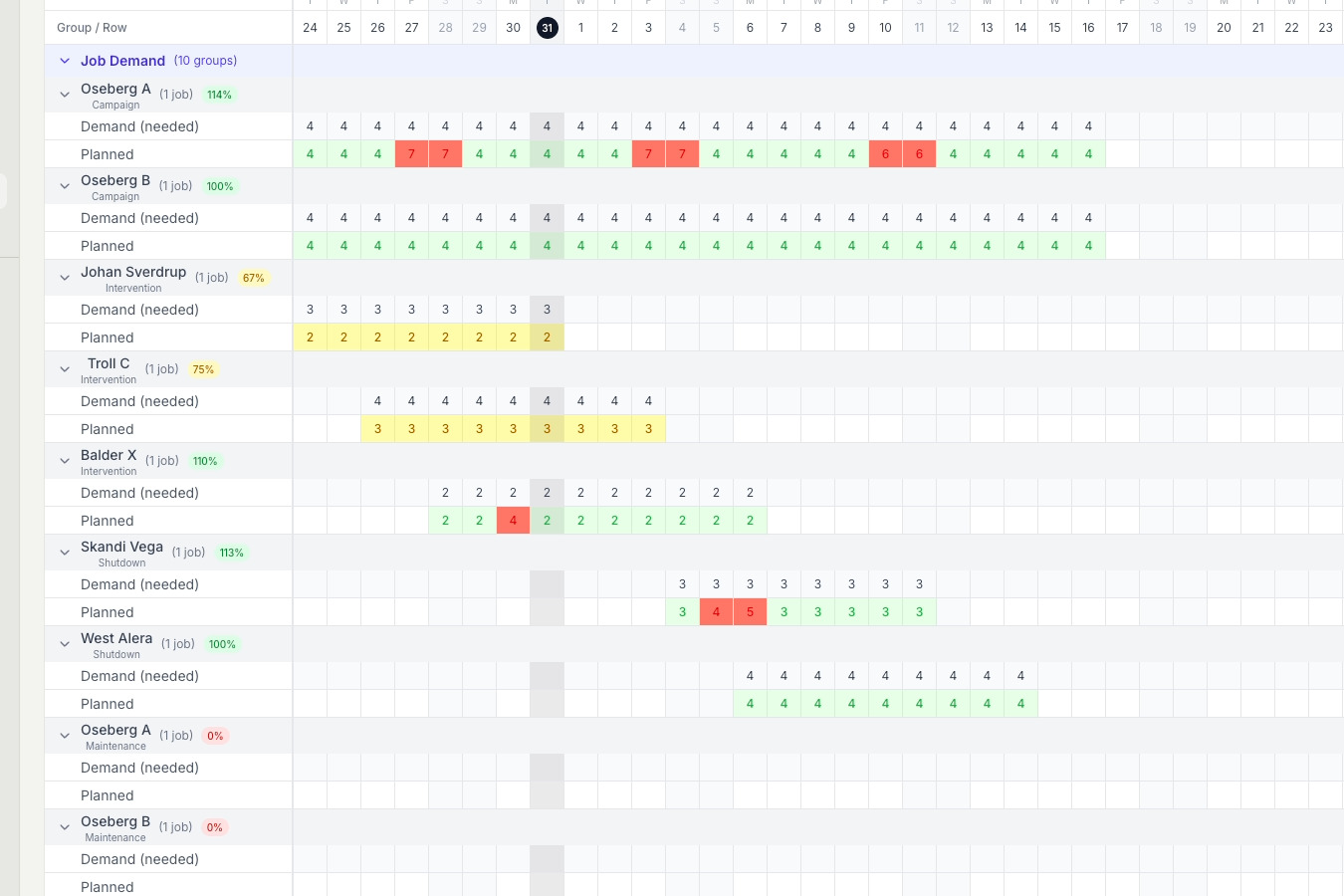
Most offshore companies built their planning processes as they grew. At 20–30 employees, a well-maintained spreadsheet is genuinely a sensible solution — it’s flexible, everyone knows it, and it requires nothing to implement. The problem is that the breaking point rarely announces itself. One day, the process that worked fine has become a source of daily frustration — and it’s difficult to say exactly when it tipped.
Here are five signs that typically show up long before companies realise they’ve outgrown their system.
Sign 1: One file, one person, all responsibility
If only one person can update the rotation plan without risking corrupting the whole structure, the system has become a single point of failure. That doesn’t mean the coordinator is doing anything wrong — it means the operation depends on one specific person always being available. When that person is sick, on holiday, or no longer with the company, the team stops and waits. That’s not sustainable, and it’s not necessary.
Sign 2: Updates create new errors
Anders swaps a shift with Karen. The coordinator updates the row in the spreadsheet. But now three other places in the document have formulas that don’t add up, colours that don’t reflect reality, and a total that’s wrong. The more employees, the harder it is to keep a single document consistent. Coordinators spend more and more time hunting for errors they didn’t know they’d made — and some of those errors aren’t caught until it’s too late.
Sign 3: You’re spending hours on something that should take minutes
A vessel changeover that is in principle an administrative task takes half a working day. Finding available people, checking certification status in a separate document, confirming nobody just returned from a long rotation, updating the plan, sending emails to confirm — each step is a manual search through different files. Combined, that’s four to six hours of coordination work per changeover. Multiply that by the number of vessels and changeovers per month, and you have a coordinator with almost no capacity left for anything else.
Sign 4: Certifications live somewhere else than the plan
The certification data is in the HR system — or in a separate spreadsheet. The rotation plan is in a different file. When someone needs to be assigned to a job, the coordinator has to check both manually. Sometimes it gets forgotten. Sometimes the HR system isn’t up to date either. The result is that someone can be sent offshore with a certification that expired last month, because none of the systems talk to each other.
Sign 5: New people learn the system by watching someone else do it
There’s no documentation for how the planning file actually works. The new coordinator shadows the experienced one for weeks or months until she feels confident enough to do it alone. The knowledge lives in the hands and mind of whoever built the system — not in the system itself. When that person leaves, the training starts from scratch again.
What does it actually point to?
These five signs all point to the same underlying issue: the planning process was designed for an organisation that no longer exists. That doesn’t mean Excel was wrong to use at the time. It means the company has grown past it.
The question isn’t “should we change something?” That question has already been answered. The question is how long you can afford to wait. Markular Planner is built specifically for companies in this transition — where the manual system has just started to cost more than it delivers.